A
t the age of 69, Mark E has almost outlived his father, who died in 1994 at the age of 70 of hereditary transthyretin-mediated amyloidosis (hATTR).
Like his father, Mark has a hereditary form of ATTR, an underdiagnosed disease that causes peripheral nerve and multi-organ damage that rapidly progresses and becomes debilitating over time without treatment.
When his father was diagnosed, there was no treatment available for hereditary ATTR. He had been relentless in seeking answers to why he was sick, going from one doctor to the next until he finally met Dr Merrill Benson at IU Health University Hospital, who diagnosed him in 1993. He passed away from the disease in 1994, a few months after his 70th birthday.
“It’s an insidious disease when you see the process,” Mark said.
A Family History
Like many people with ATTR, the journey to diagnosis was long for Mark’s father, Robert.
Originally, doctors diagnosed Robert with carpal tunnel syndrome, a seemingly unrelated symptom of the systemic illness.
In addition to carpal tunnel syndrome, Mark’s father also struggled with GI symptoms.
“My dad and my brother would go out to dinner, and sometimes my dad wouldn't get to the bathroom in time,” Mark said. “He was a fastidious guy, had all these expensive suits and took care of himself. He was a paratrooper in World War Two. It was really a humbling, terrible experience for him, and nobody deserves that.”

Mark's father Robert (left) and Mark (right) at the America's Cup sailing competition in San Diego in 1991.
By the time he saw Dr Benson, it was too late—he would have needed both a liver and heart transplant.
“He started to decline and take naps and he got thinner and thinner,” Mark said. “He was a computer guy, and he wanted to live to the year 2000 to see if all the computers stopped working. But he didn’t make it.”
Journey to Diagnosis
Dr Benson encouraged Mark and his siblings to take genetic tests to see if they carried the gene for ATTR—and at the time, all three of Mark’s siblings received positive test results, while his was negative.

Mark (right) with his brothers and sister in 2011.
It wasn’t until Mark was completing pre-operative testing for an unrelated back surgery that a doctor questioned his results. Mark and his siblings were all tested again and this time, his result was positive.
“Apparently the lab, they must have gotten all the samples at the same time, maybe switched my sister’s and mine around,” Mark said.
Realizing the Symptoms
Prior to his diagnosis, Mark experienced symptoms that began impacting his fitness regimen.
Mark has always lived an active lifestyle, which included extreme skiing, triathlons and long-distance cycling. At age 51, he helped set the age group record in the Furnace Creek 508, scoring the second and third fastest times in his two stages of this 24-hour bike race.
“I was noticing I was dropping off of my ability to perform and climb on the bike,” Mark said.
He didn’t think much of it since his doctor had originally told him he didn’t have the hereditary gene for ATTR; instead, he chalked it up to getting older. But the symptoms started getting worse.
“I’d wake up in the morning and literally would have to pry my hands open because it would be painful. And then once I got moving, it'd be fine,” Mark said. “Those were the early signs.”
In addition to this symptom, known as trigger fingers, Mark also noticed changes in his digestive tract, a symptom often associated with ATTR.
“My GI tract was really much more active than it should have been. I thought maybe I'm having too many smoothies, but it all made sense when I got the [diagnosis that the neuropathy symptoms I was experiencing were due to hereditary ATTR].”
All About ATTR
ATTR is a progressive disease caused by abnormal transthyretin (TTR). TTR is a protein produced mostly in the liver that helps transport necessary substances, like vitamin A and thyroid hormones, throughout the body. Normally, TTR breaks down and is removed from the body over time, so it does not build up in organs and tissues.
In people with ATTR, the pieces of TTR misfold and change shape. These pieces bind together to form larger structures called amyloid fibrils. Amyloid fibrils clump together in tissue and between the body’s cells to form amyloid deposits. These amyloid deposits can build up in various parts of the body, damage tissues and organs, leading to a range of symptoms and complications.
For most patients, the journey to an ATTR diagnosis can be challenging. Many patients see more than five physicians before receiving a correct diagnosis, with the full process taking on average more than three years.
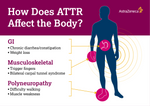
Understanding the symptoms of ATTR across the body.
For people with polyneuropathy due to hereditary ATTR, it is a debilitating disease that leads to peripheral nerve damage with motor disability within five years of diagnosis.
Raising Awareness of ATTR
Because ATTR symptoms can be similar to more common medical conditions, the disease is often overlooked and rarely diagnosed.
“I think it's way underdiagnosed,” Mark said. “I think that if they were really able to test everybody, they’d find that a lot of people have this issue.”
Working with a specialist is key to understanding and managing ATTR.
“I am so incredibly grateful to Dr Benson,” Mark said. “Because I know what would have happened otherwise. I'd be dead or dying right now. And for me, raising awareness about ATTR honors my dad. I'm paying it forward to make a difference in people's lives.”
Mark feels compelled to tell his story, so that other ATTR patients can learn from his experience and get a diagnosis sooner.
“Anything I can do to help make a difference and encourage people to get tested and doctors to get educated is really important to me. It's a way of expressing my gratitude for being as healthy as I am,” Mark said.
A New Treatment Option
Mark is one of many patients in the US living with polyneuropathy due to hereditary ATTR (hATTR-PN) in need of a treatment option.
Historically, treatment options have been limited. WAINUA™️ (eplontersen) is a prescription medicine available for the treatment of polyneuropathy of hereditary ATTR in adults. WAINUA has the potential to give much needed hope to people like Mark.
IMPORTANT SAFETY INFORMATION for WAINUA (eplontersen) injection for subcutaneous use 45 mg
WAINUA may cause side effects, including:
- Low vitamin A level, which is a serious, but common side effect of treatment with WAINUA. Your doctor should tell you to take vitamin A supplements. Do not take more than the amount of vitamin A your doctor has recommended. Call your doctor if you develop eye problems such as difficulty seeing at night or in low-lit areas (night blindness), or dry eyes. If you develop eye problems, your doctor should refer you to an eye doctor
The most common side effects include decreased vitamin A and vomiting.
Before you take WAINUA, tell your healthcare provider:
- if you are pregnant or breastfeeding, or plan to become pregnant or breastfeed. It is not known if WAINUA can harm your baby. Changes in vitamin A levels and vitamin A supplementation related to use of WAINUA may harm your unborn baby. It is not known if WAINUA passes into breast milk.
- about all the medicines you take, including prescription and nonprescription medicines, vitamins, and herbal supplements. Especially tell your healthcare provider if you take vitamin A or beta-carotene supplements.
Please see the Patient Information and full Prescribing Information for WAINUA.

To learn more about WAINUA, consult your doctor or visit WAINUA.com.
WAINUA is a trademark of the AstraZeneca group of companies.
©2023 AstraZeneca. All rights reserved. US-80189 Last Updated 12/23.
